
When choosing a cotton knit bag, check the material description, lining, main opening, strap measurements and product-specific care guidance. The visible pattern helps you choose a look, but it cannot confirm fiber percentages, interior pockets or how much the bag is designed to carry.
A textured bag can be appealing in a photograph and still leave practical questions unanswered. Use the following checklist to separate what the listing actually states from details you need to ask about. It is especially useful when shopping online, where you cannot inspect the inside or try the handles over your shoulder.
Separate the material from the construction description
Start with two questions: what material does the seller name, and how does the seller describe the bag's construction? In a product name such as “cotton knit bag,” cotton identifies the stated material and knit describes the construction. A pattern name such as cable-knit adds information about the visible design.
Keep the claim at the level given by the listing. If a description says cotton without a percentage, do not treat it as confirmation of 100% cotton. A close-up can help you see the texture, but it does not replace a fiber-content specification. The body, lining and handles may also need separate descriptions.
A current example: the Cable-Knit Cotton Shoulder Bag
The Cable-Knit Cotton Shoulder Bag is described as a cotton shoulder bag with raised cable patterns and a broad integrated strap that continues into the body. Its listed size is 36 cm wide by 55 cm tall, with style reference 8724.
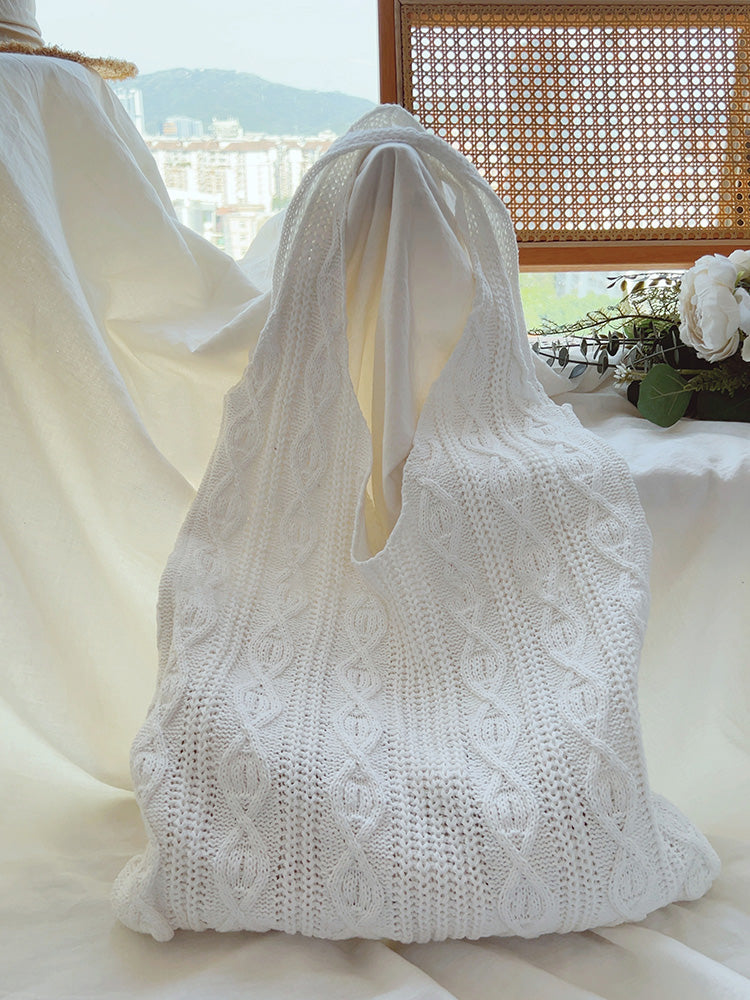
Use these stated details as a starting point. The listed overall height is not a confirmed interior depth or handle drop. The exterior photo also does not establish whether there is a lining, an internal pocket or a particular fastener. Ask about a detail directly when it determines whether the bag will work for you.
Check the lining and small-item organization
A lining is the inner layer of a bag. To understand an individual design, look for an interior photograph and an explicit lining description. If you cannot see or read those details, leave the question open rather than assuming that every bag in the same material category has the same interior.
- Ask what is inside: is there a lining, and what material is specified for it?
- Ask about pockets: how many are there, and do they close?
- Check your smallest belongings: decide whether you want a separate pouch for keys, earbuds or loose items.
- Allow for the pouch: include its measurements when comparing usable space.
Organization is a preference as well as a product feature. Someone who transfers one small pouch between bags may need fewer built-in pockets than someone who wants each item in its own compartment.
Look at the main opening separately from the body
Check whether the main opening has a zipper, snap, drawstring or no closure, using the exact product description. An interior zip pocket does not mean the entire top closes. If a photo shows a curved or narrow opening, ask for its usable dimensions before deciding whether a large wallet or other bulky item will pass through.
Our zipper versus open-top bag guide compares access and closure preferences. For dimensions, the handbag measurement guide explains why outside width, body height and opening size answer different questions.
Ask how the handles fit your routine
Integrated handles create a continuous visual line, but a photograph cannot tell you how the bag will sit on your body. Compare the handle opening or drop with a bag you already use comfortably. Include your usual jacket in that comparison.
If you already have the bag, put your normal essentials inside and try the movements you make during the day: lifting it onto your shoulder, reaching for a phone and putting the phone away. If you are ordering online, ask for missing strap measurements first. Do not infer a tested weight limit or laptop suitability from the size alone.
Read care guidance for the whole bag
A bag can have components that need different care. Follow the instructions provided for the exact item; the word cotton is not, by itself, permission to machine-wash it. Ask before using water, detergent or a washing machine when the method is unclear.
A useful message to the seller is: “For style 8724, can you confirm the fiber composition, lining and closure, handle drop, and recommended cleaning method?” Keeping the style reference in your question helps identify the correct design.
Frequently asked questions
Does “cotton knit” mean 100% cotton?
Only an explicit composition statement confirms a percentage. If the listing gives no percentage, ask for clarification rather than adding one.
Does every knit bag have a lining?
Check the individual product. Use an interior photo and the seller's description to confirm the lining, pockets and closure; the category name alone does not answer those questions.
Can I choose a knit bag for fall outfits?
Yes. Use texture and color to build the outfit, then check fit over your layers. Our fall knit-bag styling guide offers three outfit formulas using this same product example.
Browse knit bags and shoulder bags, compare the exact listings, and contact Elena Handbags for any missing detail before ordering.
0 comments